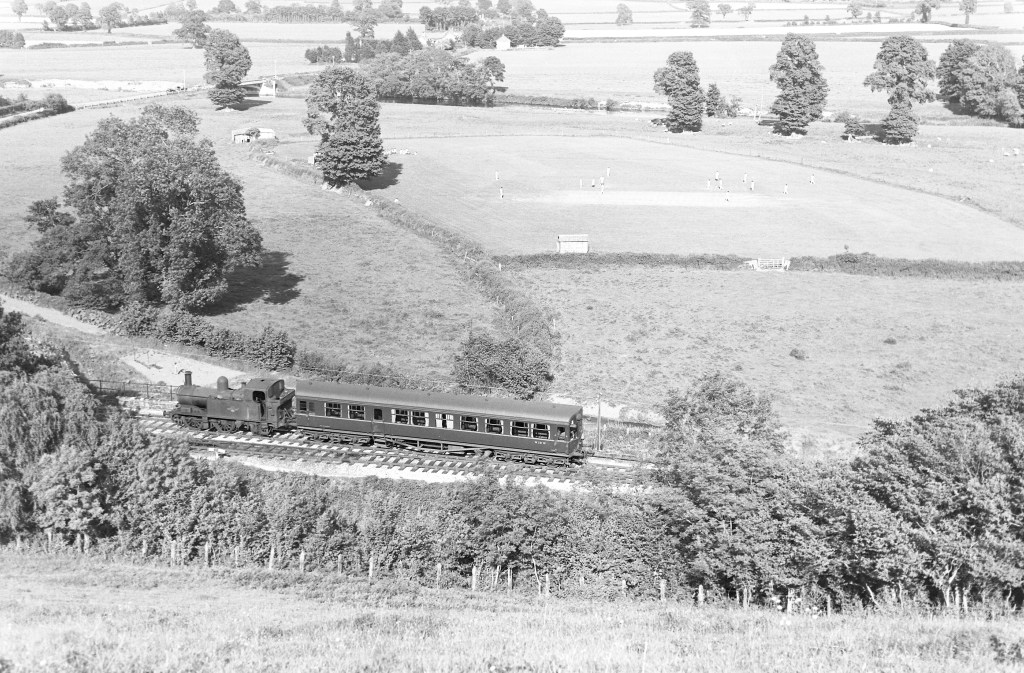
During the 1914-18 war no cricket was played, but the Club was re-opened in 1920 again on the site of the present Station Ground. The field was lent by Mr. Joe Coombe who owned the flour-mill nearby; he also supplied the horse that hauled water in a cart from the river nearby, for the
wicket. After watering, special boots’ were fitted to the horse’s hoofs to prevent damage to the ground for the wicket to be rolled.
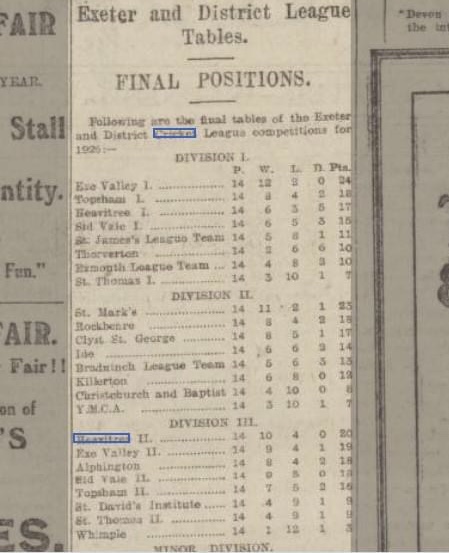
For a period of three or four years league cricket was played in the Exeter & District League; this didn’t last long as most Clubs still preferred to play “friendlies”.
The pavilion was a shed that was used for storing hay, and teas were prepared at Mill House and brought to the ground.
People playing then included Captain Bearne, Jimmy Leisk, Edwin Short, W. Chard, F.Milford and the Reverend J.H. Shaw, Thorverton vicar, father of Mr. John Shaw who played in the 30s, and was President of the Club from 1969-73.
It is important to note that Arthur Langabeer started playing for the Club at this time, aged about fourteen years. Arthur became a very influential member of Thorverton Cricket Club,
being captain for twenty-one years and was a great “all rounder” scoring many runs as well as
being a useful bowler. He was the backbone of the Club for many years, and continued playing after he gave up the captaincy until 1972. He served on the committee and was involved with the Club for over fifty years and became an Honorary Life Vice-President.
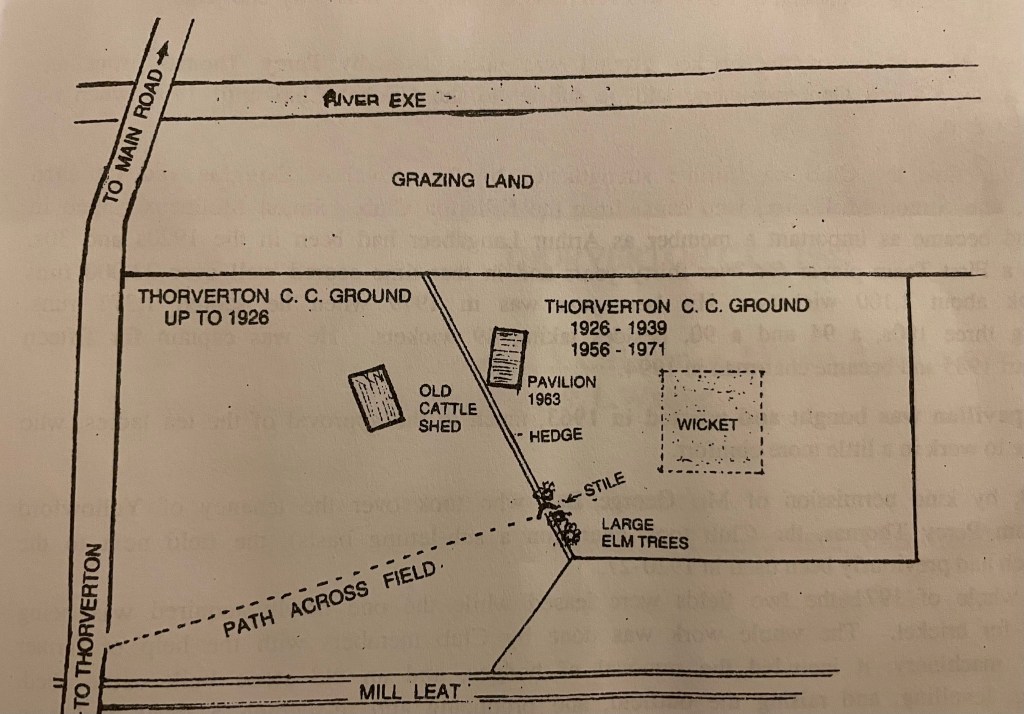
In 1926 the Club moved from the current Station Ground field next to the road, to the one over the current boundary fence , again lent by Mr. J. Coombe; this field provided a better wicket and larger outfield.
In the late 1920s and early 30s, Thorverton Cricket Club became much stronger because the
Silverton Club had folded and good players like Russell Hutchings, Jack Haydon and Jim Dymond came to play for Thorverton.
The first ATCO motor mower was bought about this time. The Club thrived in the years up to
the Second World War and became one of the leading sides in the district. Cricket was played
on this ground until 1939, when the field was ploughed up as part of the war effort.
No cricket was played in Thorverton during the 1939-45 war.
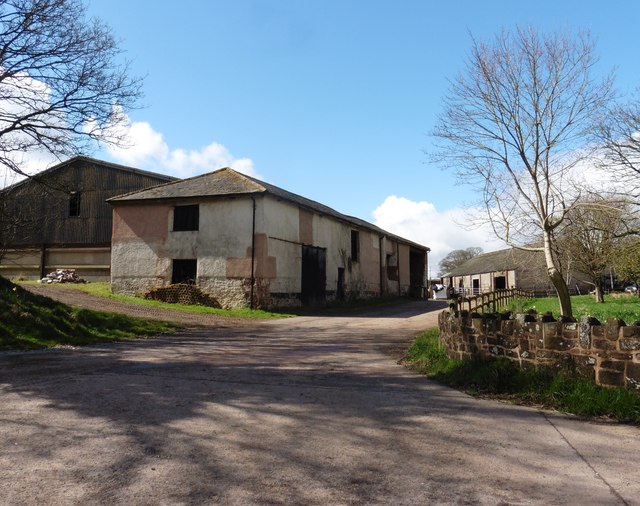
After the war, the club moved to Yellowford Farm, on ground just south of the farm buildings, by kind permission of the Thomas family, tenants of the Church Commissioners; in particular, Percy Thomas who first played for the Club in the early 30s, was with Arthur Langabeer a leading member for many years, becoming Secretary, Vice Chairman and Honorary Life Vice-President. Percy had enormous hands and visiting players used to say that if a catch was hit, it was like as if the ball was falling into a bucket. He also played Rugby for Exeter and Devon.
After a few years there seems to have been some dissension within the Club and about 1951 cricket ceased to be played at Yellowford.
However, Major Jack Hussey became tenant of the original ground by the river which had
been used before the war. It was re-secded and cricket began to be played again with Major
Hussey and ten young players from the village, together forming a team. The standard of
cricket was not very high at first, but improved rapidly, and in 1956 it was much stronger, with
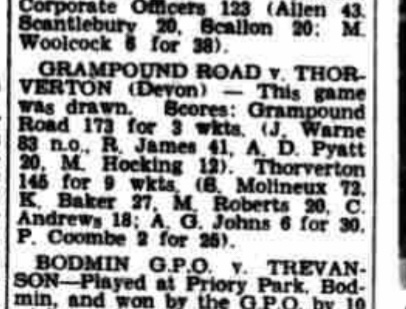
some of the older players from before the war, like Bryn Jones, Percy Thomas, Sam May, Reg Edworthy, Bill Rookes and younger ones like Gary Coombe, John White, Cyril and Ken Way, Charlie Andrews, Mike Roberts, Jim Courtney and John Carter, who became Chairman in 1963.
It is also interesting to note that C. Potter was still playing at the age of seventy-one years.
By 1959 the tenancy of the cricket ground was taken over by Percy Thomas from the landlords, the Church Commissioners, and he sub-let to the Cricket Club until 1966 when he left Yellowford.
During this time the Club was further strengthened by the arrival of Douglas and Leonard Wardle, and Simon Molineux, who came from the Killerton Club. Simon Molineux joined in 1964 and became as important a member as Arthur Langabeer had been in the 1920s and 30s.
He was a First Team player for over thirty years and in that time scored well over 23.000 runs and took about 1,100 wickets. His best year was in 1979 when he scored 1.371 runs, including three 100s, a 94 and a 90, besides taking 49 wickets. He was captain for fifteen years until 1985 and became chairman in 1994.
A new pavilion was bought and erected in 1963, much to the approval of the tea ladies, who
were able to work in a little more comfort.
In 1970, by kind permission of Mr. George Day who took over the tenancy of Yellowford
Farm from Percy Thomas, the Club took over, (on a sub-letting basis), the field next to the
road (the current Station Ground) which had previously been used in 1920-27.
For the whole of 1971 the two fields were leased while the one newly acquired was being prepared for cricket. The whole work was done by Club members with the help of farmer members’ machinery; it included the removal of hedges, and an old stone built cattle shed. ploughing, levelling, and raising the outfield, and producing and re-seeding a level wicker in the centre.
Taken from “A History of the Club 1860-1996” by John Carter
 Thorverton Cricket Club