
All the early information about Cricket in Thorverton has come from old newspaper reports of matches that were played; the first one being:-
JUNE 1860 – “Thorverton v the M.C.C. the home side lost by 25 runs.”
There were also accounts of matches played against Silverton and Brampford Speke in the
1860s and early 1870s:-
JULY 1870 – “Silverton beat Thorverton by 7 wickets at Silverton.”
JULY 1875 – “Brampford Speke (86-4) beat Thorverton, Mr. Peacock played well.”
It seems that Mr. Peacock had a big influence on Thorverton cricket for a long time from the
1860s to the time he died in 1896. There are many references to him in the reports. He would have been to Thorverton Cricket in the 1870s and 80s, what Arthur Langabeer was in the 1920s and 30s.
As far as we know Mr.Peacock came to the village of Thorverton in the carly 1870s as acurate to Thorverton Church and lived at Courthayes, which was earlier a farm house situated on the north side of Courthayes Lane which leads from the top of Jericho Street out to the so called “Common”, land overlooking the River Exe upstream from the old flour mill. Part of the stone wall around Courthayes can still be seen at the side of the lane with a Scots Pine tree that was planted on the opposite side. As well as being Curate he founded a school at his home known as Courthayes School.
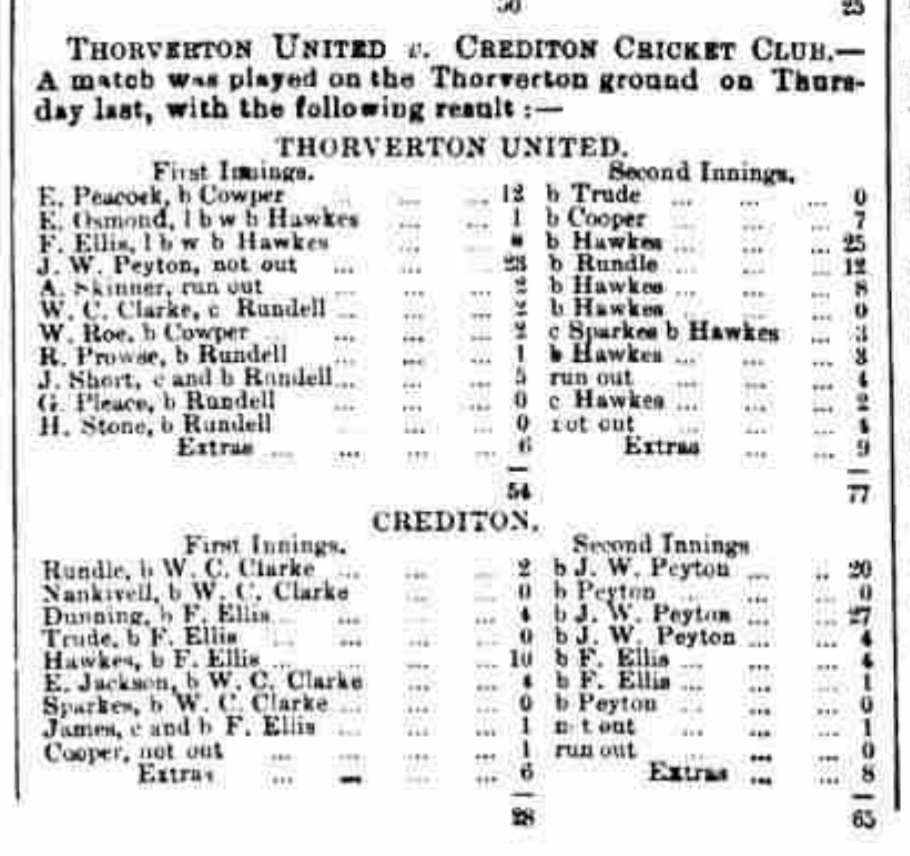
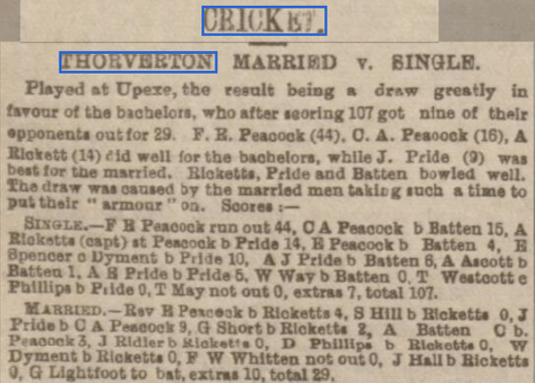
JUNE 1887 – “The first match of Thorverton Town Cricket Club, formed a fortnight earlier,
was played, they beat Courthayes School XI by 9 wickets.”From this it looks as though the Club had some sort of reorganisation and no doubt the
Reverend Peacock had a lot to do with it, as many of the reports involve the Courthayes School XI. It would seem that because of the Reverend Peacock, there was a close relationship between Courthayes School and Thorverton Town Cricket Club.
AUGUST 1877 – Two or three cricket matches were to be played during Fair week. On Wednesday Thorverton United beat Crediton by 38 runs.
After the match the teams adjourned to the Dolphin Inn, about thirty sat down and some Capital songs were sung after the cloth was removed.
From The Census of 1881:-
“Reverend Edwin Peacock vicar of Netherexd and Principal of Courthayes School” He must have given up the Curacy of Thorverton Church to become vicar of Netherexe.
Soon afterwards Thorverton beat Killerton at Killerton by 16 runs;
“The Reverend Peacock had dislocated a finger, but is progressing favourably.” Reverend Peacock also played elsewhere, “Reverend Peacock keeping wicket for Huxham.” (Huxham hamlet is
situated east of Stoke Canon on the Exeter/Tiverton road).
The word United only comes up once in the reports; whether it was a combined team with,
perhaps, Courthayes School or some other team, or perhaps it was fashionable to put United after the Club’s name like National football clubs, formed about that time.
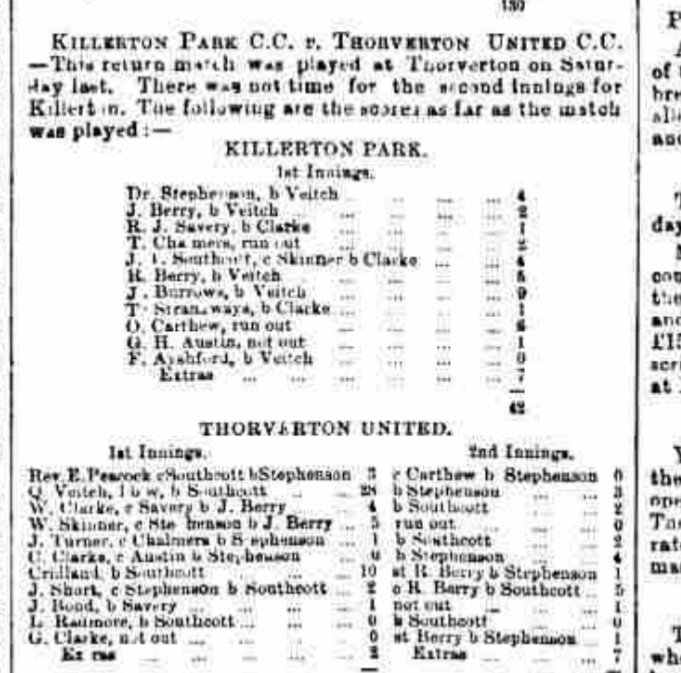
In the report of JUNE 1877 when Thorverton beat Courthayes School by 9 wickets, some
of the players were mentioned. “Players included J.T. Turner (captain), Stone, Pleace, Skinner, Prowse, and Rowe.” In the Exeter Inn, Bullen Street, there is an old picture of the
“THE ALLOTMENTS OF SITTINGS IN THORVERTON CHURCH 1840”, the allocation of pews reserved for Thorverton people, showing
their names, addresses, occupations, and the numbers in the family. Some of these names are probably related tothe cricketers mentioned above.
“Mr. Pleace who had a house in the village, was a stone-mason, and had a pew for a family of 10.”
“William Prowse, farmer of Pleasure House Estate, family of 5.” Pleasure House Estate
was a farm on the site of the present Memorial Hall, the bridge which crossed the stream to
the farm is the same as today.
Joseph Prowse was landlord of the Wellington Inn in 1840, which was re-named the
Exeter Inn in the 1870s when the Duke of Wellington became out of favour when he
took to Politics after retiring from the army. No doubt the pub was named after him when
he was the Country’s darling after defeating Napoleon at Waterloo 1815.
Thorverton Cricket Club started having their meetings at the Exeter Inn in 1956 and still
do today.
When the Reverend Peacock was made vicar of Netherexe, he probably became better off financially and moved from Courtlayes to Pynes House, in the village opposite Memorial Hall, as we can tell by two reports:-
JULY 1884 – “Courthayes School played Mount Radford School, Exeter. 3 May, 2 Huggins and a Sharland played for Courthayes.”
JUNE 1885
“‘Mount Radford School played Pynes House School at Thorverton. Reverend Peacock and his son C. Peacock both did well.”
There were two or three families named May living in the area, not directly related.
However, one of them, Herbert May was at Courthayes School and played in the July 1884
match. Herbert May was the tenant of Fortescue Farm, Thorverton, where he died in 1952; his family had farmed there for 102 years. He had a son William who did not get the tenancy
of the farm when his father died. He was well liked and known in the Cricket Club and the
village as “Fortescue Bill”, he was Captain of the Club Team in 1932.
After the May family left Fortescue, the successor as tenant was John Carter who first played for Thorverton in 1956, and was Chairman from 1963-1994.
Sam May was from another family. He ran a butchers business and played cricket for
Thorverton for many years, before and after the 2nd World War 1939-45.
May 1886:-
“The Cricket Club held a concert. Those performing included the Reverend Peacock and his three sons, Miss Osborne a relative of the Peacocks and Miss Clarke, the vicar’s daughter.”Her father was Samuel Childs Clarke M.A. born in 1821, and vicar of Thorverton from 1875-1901.
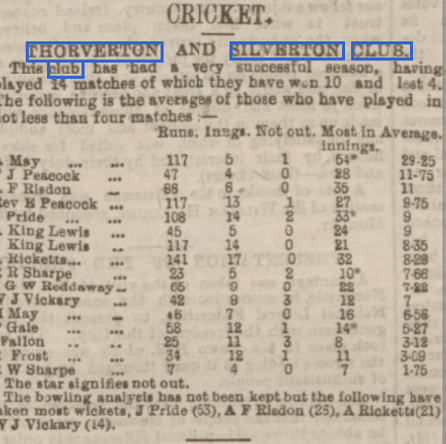
In 1886 there must have been an amalgamation of the Thorverton and Silverton Clubs.
AUGUST 1888
“Thorverton and Silverton beat the Royal Artillery at Topsham Barracks’, and in 1888 there
were separate references to a combined Silverton/Thorverton XI playing local teams.
OCTOBER 1888 – “Cricket Club dinner at the Dolphin Inn, captain Mr. Risdon.”
There is a wall plaque in Thorverton Church in memory of Arthur Felix Russian who
had been Vicar’s Churchwarden and died in 1894, and in whose memory two church bells were hung.
‘….but captain Dr. King-Lewis, a few remarks were made eulogising the manly English game of cricket, the team had played 13 matches, winning 4, losing 6 and drawing 3. We had a good slow bowler in Mr. Pride but it was useless to have a slow bowler unless we have men in the field who can take catches when they come into their hands.”
AUGUST 1892 – “Bradninch beat Thorverton and Silverton combined XI at Thorverton and the team included A.J. Pride, C. Plucknett, P. Plucknett and George Radmore”.
The census shows that these players were aged 13, 15, 10, and 9 respectively. According to this it would seem that ‘Mr. Pride’ mentioned at the Dinner was the landlord of the Dolphin Inn and the father of A.J. Pride then aged 13.
In 1893 the father of the two cricketers Charlie aged 15 and Percy aged 10, was Tom Babbage Plucknett who kept the Dairy opposite the Dolphin Inn (now the Thorverton Arms). Charlie Plucknett went to Hele’s School, Exeter, and used to walk to Stoke Canon to catch the train everyday. In 1905 when Charlie was twenty eight years old he became tenant of Pin Farm, Thorverton and staved there until 1909 when his brother William was married and. took
his place. Charlie with his wife and two daughters, Dora and May aged four and two years, went to Cruwys Morchard and farmed for three years until 1912 when his father Tom died,
after which they came back to Thorverton to take over the Berry Dairy.
Charlie Plucknett was proprietor of the Dairy until 1957 when he retired and died at his home
in Dinneford Street in 1963. His successor at the Dairy was Norman Pile.
Percy Plucknett was the first boy from Thorverton to have free education at Crediton
Grammar School, but because of the distance to Crediton, his mother had to pay for him to board at the school during the week. After leaving school, Percy Plucknett went to London and became a banker with Hambro’s in the City.
Another cricketer George Radmore aged 9 in 1892 was probably a descendant of George
Radmore senior, both being allocated seats at Thorverton Church in 1840. They were both
churchwardens and farmers. George junior was at Courthayes, where the Reverend Peacock
lived at a later date, and George senior farmed Easton Estate. In 1840 Easton farmstead was
situated two hundred yards north of Bidwell farm (north east of Thorverton), on the same side
of the Lane, but was pulled down in 1870 at the time that a new Bidwell farmhouse was built
and the Easton land taken over.
The last report before the 1914-18 war was:-
AUGUST 1897
“Thorverton beat Silverton by
an innings and 61 runs thanks to Pride and his son Bert ably assisted by Ted Coombe and
Thomas.”
Although there is no record of Cricket after 1897, it was played on the site of the present
ground, up to the start of the 1914-18 war.
Dora Plucknett remembers walking down from the village with her mother, taking tea for the
cricketers. It seems that ladies from the village provided tea, even if their menfolk were not
involved in the game.
Taken from “A History of The Club 1860-1996 by John Carter
 Thorverton Cricket Club